
Backrooms, simulacra, and the white victim complex
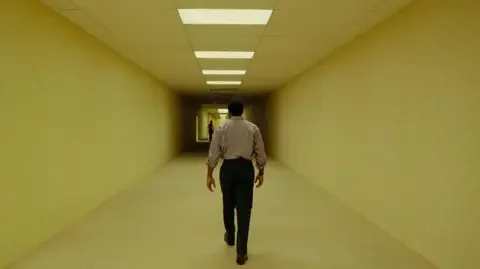
I’ll start at the end with this one.
Kane Parsons’ Backrooms (the movie, not the creepypasta) has a lot going on. Too much, I think. And in the end, and as much as I enjoyed the cinematic experience of watching it, I think it ultimately falls short, and, like our current grip on reality, is a bit of a convoluted mess. Though does that convolution actually make it the zeitgeist film of 2026? I think it does, doesn’t it? In an inverted reality, where nothing makes sense, it’s only fitting that a film that struggles to make sense under the weight of so much influence and so many themes takes centre stage as the defining film of the era. Right?
To be honest, I don’t even know what’s going on anymore. Which is, probably, the premise of this piece.
“Imagine describing a dog to someone who's never seen one before and then asking them to draw it.”
This is the film’s pivotal moment, when Clark, the furniture store owning embodiment of male loneliness and insecurity (theme #1), attempts to articulate the backrooms to his therapist, Dr. Mary Kline. It is confirmation of the film’s channelling of Jean Baudrillard’s simulacra and simulation theory, and of the backrooms themselves being a manifestation of a hyperreality (potential theme #2) - the end point of the simulacra process, by which point the boundary between reality and representation has completely dissolved. The backrooms are not, or no longer, a simple copy of a liminal, office-like space. They have even extended beyond being a copy of a copy. Entering the backrooms is to enter an uncanny valley-like liminality, the unheimlich of the unheimlich of empty or abandoned office spaces, you could say.
It is in this area where the film really works. The backrooms are legitimately creepy. Terrifying even. There is a palpable malevolence to them, even without the appearance of grotesque, simulatory human or human-like replications.
The divergence from this into Stranger Things territory, where the backrooms have already been discovered by a specific body (in this case the Async corporation), who have been probing, exploring and messing around in that space for some time, something that is reminiscent of the shows Upside Down and its discovery by the US and Soviet governments (note also the evocation of Jordan Peele’s Us, in the existence of underground/underworld copies of places and people), is where the film begins to lose that quality of unknowing, and ceases to be a compelling work.
In hindsight, I realise this divergence was unavoidable, as Async is central to the creepypasta origin story of Backrooms. But still, it’s a divergence that feels symptomatic of a broader problem within the contemporary, conventional storytelling of the mainstream as a whole - the false belief that there must be a prescriptive template that all stories must follow. It’s like everyone knows the rules of storytelling, but no-one dares to break them anymore. It’s why, or one of the reasons why, there is a prevalence of generative AI within storytelling industries. If there is just one set structural template for storytellers to follow, it makes it easier to cut a few corners and succumb to the AI temptation, especially when there is time and money involved (note: generative AI - potential theme #3).
After watching Backrooms I came across some harsh reviews. I say harsh because I think we can’t be too critical of a 20-year-old filmmaker. What I mean is, what is the best you could expect from a 20-year-old? Backrooms, the film, is a very good effort for one so young. You can even forgive the film its convolution, picturing yourself as a young creative, armed with a great concept, mind buzzing with a great many ideas and of so many things to say, given a $10 million budget to see it come to fruition on the big screen.
But unfortunately, once you take that almighty dollar, you become one of many components of an industry that takes all great ideas and condenses them into the packaged product that is a Hollywood movie. In this sense, Backrooms is in and of itself a kind of simulacra - a copy of a copy of the Hollywood movie. It is, in its original incarnation, a work of art, taken and genrefied into a processed ingredient within the staple diet of Hollywood storytelling.
Of course, conventional storytelling structures are fine most of the time, but there is an irony, I think, in a work of art where simulacra and simulation play such a pivotal role being taken and adapted for the endlessly recyclable template that is the standard Hollywood movie script. Backrooms didn’t need this treatment. Other than the Hollywood guarantee of lots of exposure and lots of dollar, adapting Backrooms into a Hollywood film appears to have desiccated it of any real artistry, and robbed it off any meaningful, artistic statement. It has lessened its overall quality, despite transforming it into a more digestible, easier to watch cinematic work. The intrigue of watching the discovery and exploration of a liminal place, one that is representative of hyperreality, though could just as easily be an imagining of being lost in an AI generated space, is usurped by an everyday story arc centred around a lonely man and his lonely therapist, whose crossed paths lead them to a conspiracy much bigger than themselves. Yes, the idea has legs, but it is a lot less compelling than the backrooms.
I think the thing I mourn most about Backrooms is the missed opportunity for any potential metaphorical depictions of online encroachment and consequent subversion of the human minds ability to understand reality that has, since the invention of social media, wreaked havoc on our political landscapes. This encroachment and consequent subversion accelerated rapidly during the early days of the pandemic, and the hysteria of lockdown conspiracies and anti-vaxx terror that we have not yet recovered from.
But in conjunction with exacerbating distortions of reality, the pandemic exposed on a depressingly large scale the extent of the damage caused by decades of neoliberal ideology and the uber individualism that is its by-product. Witnessing people who were, before the pandemic, functioning as normal, coherent people suddenly espousing quasi-Nazi survival of the fittest logic towards vaccinations and lockdown measures was especially jarring. Sentiments like, “why should I suffer because the old and the weak are in danger,” or “if lots of old and weak people die from this virus then so be it, doesn’t mean that we should stop the world,” were as strong an indicator as any I have seen to the extent of our alienation - as good a proof as any of the atomisation of individuals in capitalist society, and of that atomisation being the real cause of community breakdown and loss of compassion and empathy. To make a useful comparison, you could imagine how such a mindset would have coped during the Blitz. Such a person would likely have left their lights on, arguing that they shouldn’t suffer the inconvenience of shuffling about in a dark house just because there was a risk to the lives of others.
In essence, such logic is borne out of a profound misunderstanding of the word ‘freedom’, and of the limits to any supposed freedoms we have in a liberal democratic society. The reality is, and this used to be common knowledge, that any freedoms we have have limits, and those limits are dependent on the consideration of others. Yes, those considerations, and therefore limits, have shrunk in recent times, as collectively, as a society, we have become more self-oriented and self-obsessed. But that doesn’t mean that the initial principle still holds. Nobody has total freedom. You cannot say or do whatever you want, whenever you want. And sometimes, there is a responsibility to act in accordance with the greater need, for the greater good, for the benefit of all, even if that inconveniences a great many people.
The fact that conspiracies around lockdowns and hysteria around vaccinations still linger, as if the lunatics were right the whole time, reveal the extent of our current malaise. Rather than accepting the temporary nature of lockdowns, and the fairly modest uptake in COVID vaccinations, as proof that no conspiracy regarding COVID-19 as a means to ‘control us’ (whoever ‘we’ are) ever existed, that vaccinations were always optional, despite the equally unhinged call by some to make them mandatory, you still hear idiotic notions of, say, living in 1984, that Orwell had it right, despite nothing bearing any resemblance to Orwell’s fictional, totalitarian nightmare exists outside of North Korea.
Though you can understand why, due to the nature and magnitude of what was going on, the year 2020 saw a collective detachment from reality, in the Western world, as great as anything you could have imagined beforehand. It was a moment in which reality, as in the general understanding of things, collapsed in on itself, when the mish-mash of ideas, influences, opinions and of all those 20th century moments in time that refuse to leave us, were condensed into one incoherent mess.
When George Floyd died under the knee of Derek Chauvin, and the moment of his death was shared with the billions of people inhabiting this planet, I saw it, like most people, as a what the fuck moment. My initial, natural response was, “What is that guy doing? Get off him. He’s telling you he can’t breathe, dickhead. Get off.” Then, when the protests began, I wasn’t surprised in the least. It was the US of A, after all. In the context of US history, it was following a trajectory set in motion long ago - meaning that the protests were inevitable, that the sight of a black man dying under the weight of a white man’s knee on his neck was, for black Americans, a deeply, and understandably, upsetting sight, more so than any other ethnic group could fully comprehend.
This was true whether George Floyd was murdered by a racist cop or not; whether he was killed because he was black or not; whether he was killed deliberately or not. To insist on ignoring the racial aspect is to simply not understand, or care about, the horror that is American history, and its treatment of black people. And if anyone is going to overwhelm society with mass protests in response to police brutality, it is going to be black people. Why? Because it is black people, more than any other group, who have been subjected to it.
Yet before coming to the point, and if we are to understand the whining and tantrums of the white victim mentality that has sprung up in the wake of George Floyd’s death, there is, as always, some nuance we have to address. There is some truth in the madness.
One of the most triggering sights for many people in the UK, of all backgrounds, was the weird sight of knee bending before football matches, by politicians, by local councillors even, and at protests. Though for Colin Kaepernick, and Americans fighting racism in the US, bending the knee while the US national anthem played made perfect sense. But for the rest of us, appropriating that gesture was, to speak plainly, pure cringe to say the least.
The performative nature of it - the falseness of it - pissed off a lot of people. As did the BLM thing. Again, in the US, BLM might make sense, but in the UK, not so much. The truth is that black people in the UK have not been murdered by the state, or have seen murders covered up by the state, on the scale that has been seen in America. By some immeasurable distance, too. That’s not to say the UK isn’t, or hasn’t been a racist country, or that non-white people have been treated appallingly. It’s not to say that nothing should be done about our problems. Don’t worry, I’m coming to that. All I am saying is that appropriating a US organisation, whose existence and slogans only make sense in the context of the USA, a catastrofuck of European colonialism and genocide, that therefore can never function as a coherent nation state, or offer anything good to the world in its current, and historical, state of being, is absurd.
On top of all that, is the fact that if George Floyd’s death had only been read about, and not seen, very few people in the UK would have hijacked the cause for their own benefit - which is undeniably true by the way. If you genuinely believe that corporations and politicians adopted BLM slogans and bent the knee out of sincere anti-racism, as opposed to smelling some good PR, then you are tragically naive. But whatever. The occurrences of BLM slogans and bends of the knee (as if Keir Starmer would ever bend the knee in protest to the US national anthem lol), were an embarrassing replication of what was being seen in the States. Though it was surprising, in hindsight it shouldn’t have been, considering the influence Americanness has had on UK generations since the 1980s, an influence that is now so bad, that there are English people actually pronouncing the word ‘arse’, ‘ass’ (incredibly jarring and makes me want to rip my ears off). I swear to god, if I ever hear pavement being called sidewalk…
Anyway, the point to all this is that we cannot explain the events of the last week without that BLM context. Over the last week, I’ve been seeing a ridiculous number of social media posts by middle-aged white men bending the knee in honour of Henry Nowak. The slogan White Lives Matter is doing the rounds. And then, yesterday, 2nd June, thousands of white people descended on a police station in Southampton chanting “I can’t breathe”. Okay, the last one makes sense, considering they were the last words of Henry Nowak, as they were the last words of George Floyd. But using them in the way they were yesterday was truly obscene.
There are some key differences in the tragic deaths of Henry Nowak and George Floyd, but one that matters more than any other in dismantling the ongoing narrative on the Right - Henry Nowak was not killed by the police. One of the wounds, inflicted by his murderer, Vickrum Digwa, would have been fatal no matter how he was treated in police hands. The injustice done to Henry was in his treatment as he lay dying from his stab wounds, with the police believing the lies of his killer, who claimed he was acting in self-defence after being subjected to a racially motivated assault (this has been proven to be categorically false), and handcuffing him, with his hands behind his back, as he was bleeding out from his chest and legs. George Floyd, of course, was killed by a police officer. There was no-one else involved in his death.
There are some others considerations to make in Nowak’s treatment, that in no way serve to admonish the officers who handcuffed him, but, again, are mentioned only to bring a sense of rationality to the irrational reaction that is being played out. Firstly, it is not uncommon for people to feign injury whilst being arrested. Bear in mind that it was Henry’s killer himself who called the police, who gave the false story of being the victim of a racially motivated attack, and who met officer’s, with his family, all of whom acting as accomplices (his mother has also been imprisoned for her role in hiding the murder weapon), at the scene, bombarding them with his fictional version of events. As soon as it became clear that Henry had been stabbed, that he was losing consciousness, the handcuffs were removed and attempts were made to save him.
As bad as the bodycam footage is, then, it is proof of police negligence, disgraceful in and of itself, and the individual stupidity of the officers who attended. But it is not evidence of anti-white racism carried out by white police officers. It isn’t even evidence of police officers fearful of being seen as racist. Only the biased, the usual suspects acting on their own agendas, without genuine consideration for the victim and his family, would push this narrative, and only a genuine idiot would believe it. Unfortunately, we’re not short on them.
If this has become a tangent then that’s because I’m writing in anger at the insanity of this world. And if you are scratching your head wondering how a review of Backrooms got here, then let me walk you back.
White Lives Matter, and the idea that there is anti-white racism within the overwhelmingly white Metropolitan Police, or featured in the policies of white political leaders, or that white people in the UK are being subjected to racism, or being harmed by anti-racist actions, belongs in the backrooms. It is a product of an upside down, an underground inversion of the world, something evocative of an Us universe. It’s a simulacra - a copy of a copy, where the original copy has no original. They’re calling Henry Nowak the real George Floyd. Some are even bringing up Stephen Lawrence. The truth is that there is no white equivalent to Stephen Lawrence. Institutional racism cannot exist towards white people in a predominantly white society. It is impossible. To believe it does is to fail to understand what institutional racism means.
Imagine describing racial injustice to someone who’s never experienced it before and then telling them to act as if they have…
