
More thoughts on alienation, short fiction and the "intense awareness of human loneliness", and Kit de Waal's Supporting Cast
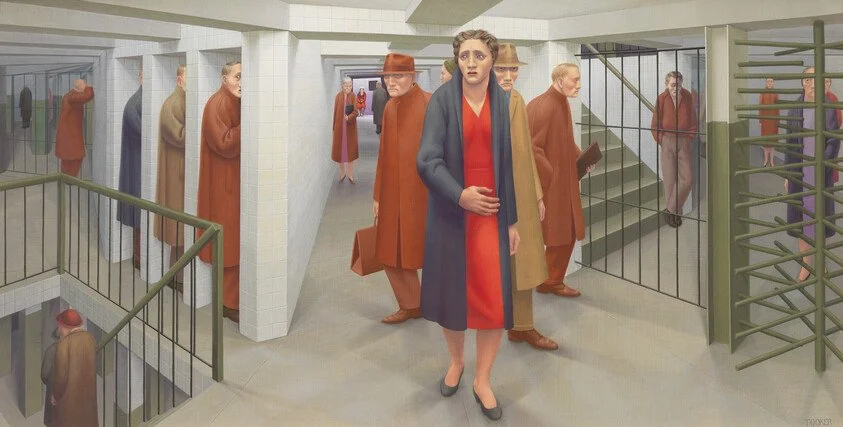
George Tooker, The Subway, 1950
“What it (the short story) has…is a submerged population—a bad phrase which I have had to use for the better. That submerged population changes its character from writer to writer, from generation to generation. It may be Gogol’s officials, Turgenev’s serfs, Maupassant’s prostitutes, Chekhov’s doctors and teachers, Sherwood Anderson’s provincials, always dreaming of escape.”
-Frank O’Connor, The Lonely Voice: A Study of the Short Story, 1962
Smack bang in the middle of the 20th century a book appeared in the US that would defy initial “argument and smears” from academics by surpassing over a million sales and making a minor celebrity out of its author. That book was The Lonely Crowd: A Study of the Changing American Character, and the author, David Riesman (the production of the book also involved Nathan Glazer and Reuel Denney as collaborators), would find himself on the cover of Time Magazine in September 1954 – a direct result of the book’s success among American readers of the time.
As you can probably gather from the book’s title alone, Riesman et al. were exploring states of isolation and generational detachment, particularly within urban and suburban settings, that had emerged during the formative decades of the century. Likewise, we don’t need too much background on top of the obvious fact that everyone knows – that the 20th century was a 100-year-period of immense, previously unimaginable, transformation within human societies and ways of life – to intuit the book’s conception, and its success, as part of a wider, generally accepted sense of these states of isolation and detachment. What the book’s success shows is that there was an awareness of significant shifts having occurred within American society, particularly among the city dwellers and suburbanites, that had affected human relationships and been responsible for an underlying malaise – and that people were seeking answers.
This sense of loneliness and underlying malaise is a regular feature of American artistic outputs throughout the mid-to-late 20th century. It is there, most viscerally, in the paintings of Edward Hopper and George Tooker, and in the writings of the Beats. It is there, perhaps most famously, in novels like Salinger’s The Catcher in the Rye (1951) and films like Scorsese’s Taxi Driver (1976). But these are just a few of a great many.
Yet as compelling as the American case is, and contrary to the belief of Riesman and other American minds, it is not one that is unique to America itself. And though Riesman acknowledges Marx and Marxist thought as providing some answers to the American malaise, he sees it in the same way as Arendt and Simmel, as being different to alienation in the Marxist sense. As I noted in a recent piece on the supposed differences between individual alienation and individual atomisation, it is impossible to dismiss Marx when seeking answers to the modern mysteries of isolation, search for meaning, and the general sense of disconnect within our societies. Why Marx is so overlooked here can primarily be put down to two things – taboo around Marx’s ideas and the state of capitalist realism.
These two things overlap as a general acceptance of the world as matter of fact. Nobody, in the general sense, thinks about Marx or capitalism simply because they don’t think about their isolation, detachment, or search for meaning as a consequence of fundamental, unavoidable, systemic flaws. They think of it through the reality of individualised society. While existential crises are very real, and the search for the meaning of life both universal and personal, capitalist society, and the modern emphasis on the individual, is a significant exacerbation of both social disconnect and the internal void.
There is also the general acceptance of historical and philosophical oversights that, deliberate or otherwise, are taught as basic truths. These oversights can even affect the grasp on Marx’s work among communists/Marxists themselves. I am talking of course about the Soviet Union (particularly Stalin, but Lenin and his army of Bolsheviks also), Mao, North Korea, and Cambodia’s Khmer Rouge, led by Pol Pot.
Not to say that these examples were, or are, not communist in name. But whether they are communist in practice is, in the case of North Korea and Cambodia under Pol Pot, totally absurd, and in the case of the USSR and China, highly debateable. Lenin, Stalin, and Mao all diverged from Marx’s ideas and thinking in various ways and to various degrees. All were wrong, and have been proven to be wrong, by their insistence on one, fallacious, premise alone – that a successful, genuine, communist/socialist society could be achieved by applying Marx’s framework to agrarian, “underdeveloped” nations (“underdeveloped meaning not capitalist, industrialised or not capitalist and industrialised enough – a word steeped in capitalist realism but is the common language used to describe, say, 19th century Russia), and their replacements of Marx’s belief in spontaneous revolutions led by the masses with their own belief in, and emphasis on, elite (and total) control of a strong nation state.
By diverging from Marx in such ways, and applying Marxist ideas to conditions irrelevant to Marx, Lenin, Stalin, and Mao all inflicted upon the people under their rule a social experiment. For the Soviets, this experiment would end in disaster in the late 1980s, whereas China has since adopted a capitalist/communist hybrid, with state owned businesses operating within the capitalist free markets. Most crucially, all three would abandon the basic tenet of internationalism in favour of the tribal insularity that afflicts all nations.
Why modern-day leftists get sucked into the USSR/Mao thing is something for them to explain, but I’d imagine that, in the case of Lenin, and possibly Mao, their acting in good faith, that is to say, that they genuinely abhorred capitalism, were correct in doing so, and didn’t want their respective countries to have any part in it, is appealing. Both Lenin and Mao were correct in their assessments of capital as being parasitical in nature, correctly identifying the exploitation of the masses through control of the labour process, and the inherent imperialism and colonisation that exists as a basic requirement of capitalist economies. Both wrote compelling works, full of great ideas and fantastic slogans. Though I’d argue that the jury is still out on Mao, Lenin, I believe, was sincere in his aims. While Stalin was an absolute bastard. And a nut job.
Sticking with the American case for a moment, it is not only Marx that the American mind has often overlooked in their study of urban and suburban isolation. Turning once more to the arts for evidence, I think of Baudelaire and the Parisian flaneurs, those detached observers, wandering the streets of 19th century Paris. There is also someone like L.S. Lowry and his matchstick men – the obscured figures of the industrialised city. Both artists had no concern with the developing American cities, yet their shared awareness of isolation and detachment can be applied to the American experience, just as Scorsese’s Taxi Driver or Salinger’s The Catcher in the Rye can be applied to Europeans and, indeed, habitants of capitalist economies everywhere.
And while the American self-centredness is understandable for outsiders when looking at the sheer scale of American life and culture, I would go as far to say that the American mind’s overlooking of Marx, as well as the art of a Baudelaire or Lowry, is indicative of American exceptionalism, as well as a general sense of denial, or perhaps more correctly, arrogance. It is, I would argue, a reflection of the general American belief, one that is truly unshakeable, in the American way. To the despair, and at times amusement, of the rest of us, the global hegemon is not shy to – in the words of Peter Griffin - insist upon itself. And as we all know, this self-insistence is truly toxic when applied to a malevolent superpower seeking dominance over the entire planet through its control of global capital and natural resources.
The perception of a lonely crowd formed the basis of one of the seminal works of literary criticism – Frank O’Connor’s The Lonely Voice: A Study of the Short Story (1962). Identifying, correctly, that in short fiction there is “always…this sense of outlawed figures wandering about the fringes of society,” O’Connor distinguishes the short story from the novel in the former’s “characteristic” concern of “an intense awareness of human loneliness.”
Short fiction, O’Connor argues (as seen in the quotation used to open this piece), consists solely of “submerged populations” – outsiders, loners, the marginalised. And because this is undoubtedly true, it is very much worth considering, first of all, the emergence, evolution, and functioning of short fiction within a capitalist world – alongside alienation and later variants of alienation – while making note that O’Conner’s use of the term “submerged populations,” which he “had to use for the better,” is at the same time an indicator of his own ignorance, or outright cluelessness, as to why and how these populations came about. Though “submerged populations” isn’t as bad a phrase as O’Connor seemed to think, he could have just said “alienated populations.” The fact he didn’t tells us that he was very much of the Riesman school, which does make for a more compelling study into social disconnects as it presents the issue as a mysterious one. Only there isn’t really any great mystery to it at all.
But what about short fiction writers themselves?
Notable early ventures into the form feature the appearance of the lone wanderer and isolated individual. Poe’s ‘Man of the Crowd’ and Gogol’s ‘The Overcoat’ appeared early in the 1840s, a few years before Marx’s first documented work on his theory of alienation. This would suggest that a novel sense of alienation was prevalent among those living in the new cities.
Then, in 1853, Herman Melville’s short story ‘Bartleby, the Scrivener: A Story of Wall Street’ appeared – serialised anonymously in Putnam’s Magazine. This story was in effect a fictional account of experienced alienation within the workplace – of the estrangement between worker and their product. This story, and its depiction of alienation, takes on more significance in the likelihood that Melville would have been totally unaware of Marx, let alone his theory of alienation, and was therefore writing from his own understanding, or interpretation, of the new world.
The intrigue conjured up by these stories, then, is not within the fiction itself. Just as intriguing is the insight given into the real world that each of these stories were depicting and how each one correlates in one way or another with Marx, despite no direct link between them. So while Marx was articulating the condition of alienation within social, political, and economic theory, the existence of it was being depicted, in the absence of any Marxist influence, in the works of writers like Poe, Gogol, and Melville. This has been the case with the short story ever since. Though we can speculate endlessly as to why this is, the crucial thing is to acknowledge it as fact – that the short story as a form, and by its nature, is one solely concerned with subjective focus, and is built on the foundations of the fleeting moment. Over time, and due to the revolutionary inputs of writers like Joyce, Mansfield, and Hemingway, short fiction has evolved into a form most capable of capturing the “fragmentary nature” of modern life. This has happened, of course, within an increasingly atomised (fragmented) society.
The aforementioned are, like their nineteenth century predecessors, notable in the context of this piece in that Marxist thought was not informing their work (though I say this tentatively in the case of Joyce, who was a socialist). And there are many others who have emerged since, all of whom have produced incredible short story cycles (my favourite form of fiction). Starting with Dubliners, works like Sherwood Anderson’s Winesburg, Ohio, V.S. Naipaul’s Miguel Street, and Hubert Selby Jr’s Last Exit to Brooklyn have painted visceral depictions of alienated states within capitalist settings (the capitalist city in Last Exit…, the rural town of capitalist America in Winesburg, Ohio, and the colonised land in Miguel Street) none of which having been informed by Marx’s theory. You could even argue, in each case, that there is no interest on the writer’s part in the lonely crowd, or loneliness itself. And yet, it is there, and palpably so, within the context of a specific place. In each work, place is a character in and of itself, central to the work as a whole, which has profound impacts on its inhabitants. We can not ignore the fact that these places are capitalist societies, places burdened by capitalism, or places stolen and looted in pursuit of imperial dominance, even if there is no awareness, or interest, of that fact on the authors’ part. As depicters of real-world places, all components of that place are of importance. What informs place in the real world informs the depicted works even if on a sub-conscious level. It is, in essence, a psychological state of being that the author, having lived in the real-world place, is as beholden to as everyone else. The author is not immune from these states of being. And while they can gain awareness and understanding of them, it doesn’t make for better or worse literary outcomes, simply because the influence is there whether they know it or not. This is one of many things that makes literature, and literary criticism that takes in wider contexts, so compelling.
But the short story cycle, of course, is not rooted to depictions of place. Raymond Carver’s What We Talk About When We Talk About Love and Jennifer Egan’s A Visit from the Goon Squad are two personal favourites of the form that do not have sense of place at their core. There are innumerable other examples. The latest one that I have come across and read is Kit de Waal’s Supporting Cast.
Accurately described as a “series of vignettes,” Supporting Cast is more a work of flash fiction than short fiction. Interestingly, the stories all involve secondary characters from her previous novels. Being the only book of de Waal’s I have read, I wasn’t aware of this when going into it, and I do wonder if my reaction would have been different had I already been introduced to the characters. Yet the fact that I hadn’t, and still enjoyed the book, means that an interesting dynamic is at play with the work.
Having no knowledge of who these characters were and why they were featured so briefly with seemingly no connection (stories are titled by name, place, and year, such as ‘Carol Rycroft, Bristol, 1981’, and are not sorted chronologically), I read the work as an interesting glimpse into people across time and in various places. Kind of like looking at paintings in an art gallery – you just see the moment in time, and that is enough to provoke a sense of wonder.
In this understanding, the book’s title read to me as a nod in some way to atomised society, dedicated to a Supporting Cast of everyday people who are seldom seen are heard from outside of a relatively small network of family, friends, and work colleagues. The stories themselves brought to mind Burgess’ summarisation of Joyce’s genius, “the solemnisation of drab days and the sanctification of the ordinary,” that is a hallmark of all Joyce’s work. In each story, the casted eye over each character beheld them with the same sense of tenderness, love, and basic humanity, a deep interest in who they are and how they are, whilst also sharing the short story form’s inherent detachment, the refusal to provide answers, or closure. The “intense awareness of human loneliness” as matter of fact.
While this also applies for readers already acquainted with the Supporting Cast, having that acquaintance changes the meaning of the book. As de Waal explained in an interview for The Guardian, a motivating factor in the writing of the book was to give readers more insight into the characters. In what will be familiar to all fiction writers, de Waal speaks in the interview of her characters having a life “beyond the page.” Rather than “waiting in the wings to walk on,” the Supporting Cast are living their own lives outside of the book. This is an insight into the mind of the writer and is, perhaps, an indicator of how the writer deals with their own loneliness and/or attempts to think and do something about the human condition.
As mentioned earlier, the writer is not outside of society, and is therefore not unaffected by social/cultural influence. For de Waal, a major concern in relation to the search for identity is cultural. Having, in her words, “so many overlapping and disparate identities” is a direct cause of colonisation. Being from both St. Kitts and Ireland, de Waal’s search for meaning within fiction is not universal, but it remains within the same social construct that alienates so many of us.
This impact of colonisation is one that is also shared by Joyce, as well as Naipaul, and it would be neglectful, and disrespectful, of me to not say a few words in relation to it despite being so woefully unqualified (I am a white English man, so very much a beneficiary of British imperial colonialism).
As masters of global capital, and looters of the planet, capitalist societies, particularly urban and suburban settings, are haunted as much as they are disrupted by the horrors inflicted upon the Others – the wretched of the Earth – and cannot be overlooked when analysing social alienation and/or atomisation, whether through the context of isolation, search for meaning, or the internal void.
Nationalism’s 21st century existential crisis is one caused directly by imperial colonialism. It is a perverse existentialism, absolutely, but it is one that shows how destructive imperial pursuits have been. Those who dehumanise others dehumanise themselves. This is the current state of the white nationalists in Europe and the US. Full of hate, incomprehension (born out of general stupidity), insecurity, and ignorant in the extreme, it would be funny if it wasn’t so harmful to others.
This is not the concern of writers like Joyce, Naipaul, or de Waal, of course. But it is relevant to their own stories. The world would be a better place if more people read them.
