
Thoughts on atomised society and why atomisation is related to alienation - as opposed to being a distinctive phenomena
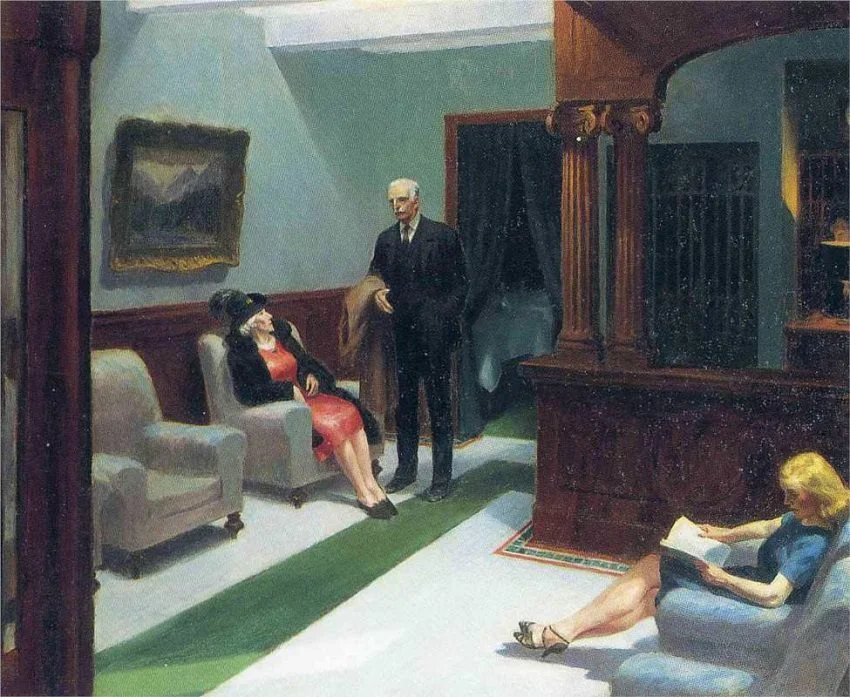
Edward Hopper’s Hotel Lobby, 1943
The fact that alienation, in the Marxist sense, has developed an extra layer since Marx’s time is not, I believe, talked about enough. This is because that layer, often referred to as atomisation, has been talked about primarily, by early-to-mid 20th century thinkers such as Georg Simmel in his work, The Metropolis and Mental Life, and much later, Hanna Arendt, in her work The Origins of Totalitarianism, right up until the present day, as a separate, distinctive phenomena – a social breakdown that Marx either had a blind spot towards, being hyper-fixated on the labour process and the effects on the worker, or failed completely to anticipate. This is a fallacy, in my view, that needs to be addressed.
To make the case as to why, we first need to look briefly at the four stages of alienation from a modern perspective:
1. Alienation from the product of labour.
Perhaps the most straightforward point – workers do not own the thing that they produce. It is something alien to them, not of them or for them, produced for the sole benefit of someone else i.e., the capitalists (meaning employer). The worker has no attachment to the thing itself, nor any control over it. Instead, the thing, and the owners of the thing, have total control over the worker, being depended on by the worker for survival.
Forming his theory of alienation in 1844, it is not difficult to grasp why Marx would have focused on jobs involving manual labour. It is also not difficult to apply alienation from the product of labour to other kinds of work, in particular the bullshit job aka office/corporate job.
These jobs have reached a level of absurdity that Marx would clearly have had a field day with. Working with abstract data sets or, worst of all, in customer service, such work offers nothing in terms of value or meaning, inflicting drudgery onto the individual, reducing them to human automaton.
Essentially, no matter what the job, the worker does not own or have any personal say in what is being produced or served. The worker’s primary function is to be a cog in a much larger machine.
2. Alienation from the production process.
The worker produces a thing neither for love nor pleasure, yet the life of the worker is put into it regardless. Labour is forced, done without choice, as a means of survival or for greater material wealth (something that is tied in with commodity fetishism).
Ultimately, the production process is repetitive and demoralising, stifling the individual to the point of total disconnect. Whether working a manual labour job, a bullshit job, or as someone paid to perform a service, the act of production, or the act of serving, ruins human potential by robbing the individual of time, energy, and joy.
3. Alienation from species-being (Gattungswesen)
Arguably the most complicated stage, alienation from species-being is to be cut-off from the very things that make us human. For Marx, this involves free, conscious, and creative activity. Abilities of forethought, creativity, adaptability, and socialisation, for example, are abilities that separate humans from all other animals. Humans are unique in that they can transform nature and themselves through conscious activity, by design. Under capitalism, humans are deprived of performing free, conscious and creative activity, reducing our natural activities and behaviours to a fight for survival.
In our atomised society, the alienation from species-being has reduced human beings, in a systemic sense, to units of value – economically, politically, socially, and culturally speaking. This is seen in things like market value and personal brand. Our very sense of self is constructed by things of value, or what we deem to be of value, in order to survive our environments and ensure that physical needs are met.
4. Alienation from other human beings
Under capitalism, humans are forced into competition against each other in, for example, the job hunt and/or a work promotion. Think also of a self-employed person’s competition with others in their industry or field, or major companies, and the fight for customer bases. In atomised society, the extent of this alienation is seen in the types of environments we inhabit, and how we exist within them. Whereas Simmel saw a physically close but emotionally distant collective as an inevitable by-product of urbanisation, he didn’t see, for whatever reason, Marxist alienation, and capitalist design, as informing those urban environments.
Though human separation features throughout human history in, for example, established hierarchies, religious and tribal affiliations, and legal statuses, the systemic condition that transforms humans into competitors for work (and survival) is, or was in Marx’s time, a novel one. For the first time, human relations are mediated by the exchange values and commodities of what is now a global system. Society is split in accordance with capitalist demands. In Manchester, this has been seen by the development of slums followed by high-rises and overspill estates, all of which have disrupted and/or destroyed community make-ups. It is important to note here that while humans have long been wary of strangers, or the Other (many see this as a natural, inherent instinct – a state of evolution – born out of a violent world and the assumed fact that survival equates to establishing dominance), antagonism is exacerbated by the manner of community disruption – in the context of people being displaced because of a lack of work or space, away from established networks, and into a different social environment.
Looking at the world in 2026 from a Marxist perspective, it is painfully obvious that every aspect of life, including human relationships, has suffered immense and potentially irreversible damage from prolonged exposure to capitalist ideology, and that the persistence with the capitalist model has been catastrophic for all life on earth. Alienation is central to the human inability to address this reality, even in our current, perilous state.
By treating atomisation as separate to Marx’s framework, rather than its outward social manifestation, thinkers like Arendt and Simmel appear to have underestimated the extent to which capitalist accumulation drives both the internal detachment of the self and the external atomisation of the collective. In short, the capitalist economic model by which we structure our society is directly responsible for the alienated individual and the shattering of social fabrics and community relations – thus creating an atomised society of self-interested individuals existing within their own insular networks of friends, family, acquaintances, and work colleagues.
